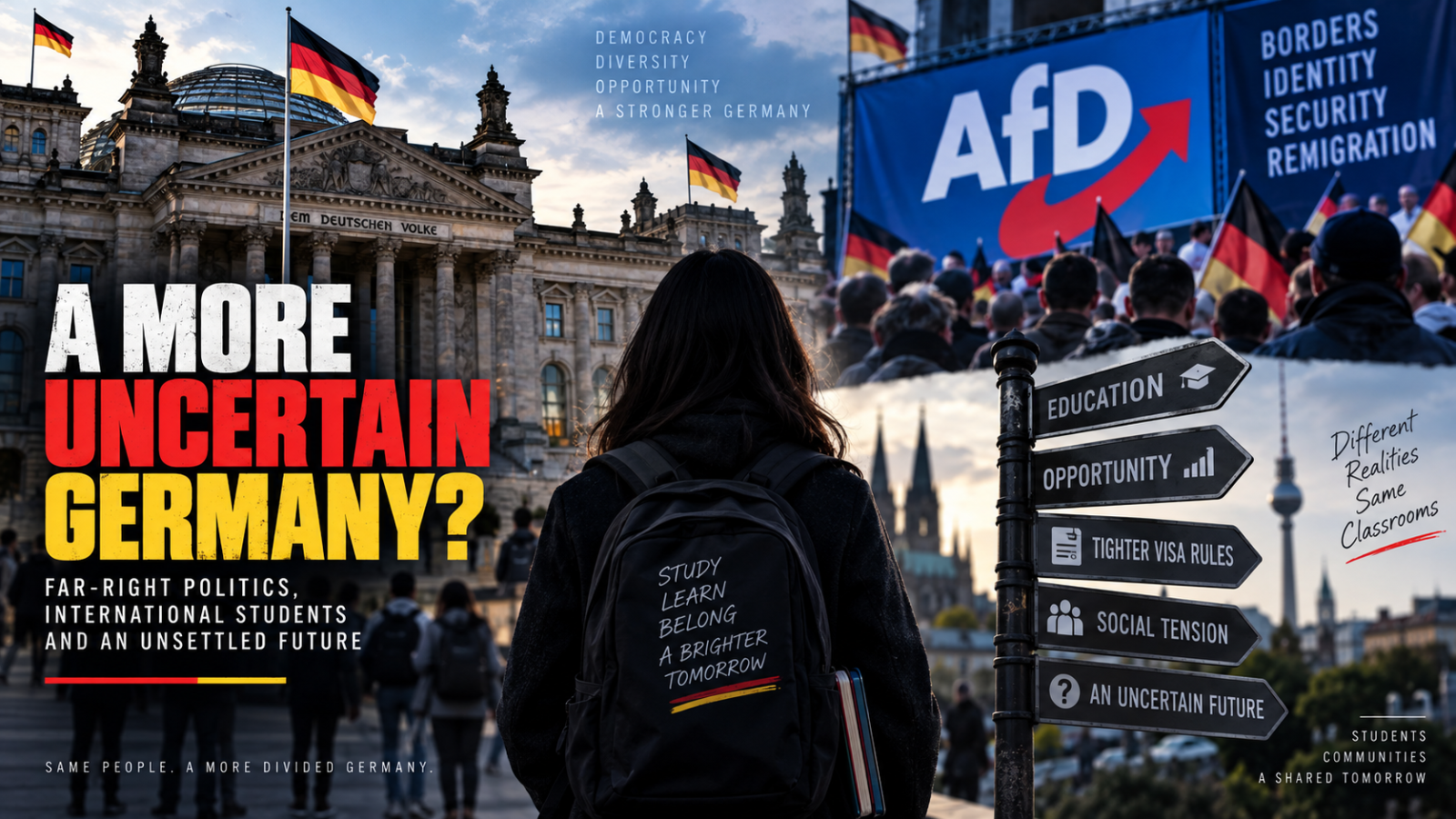
The short answer: the law still blocks the far right from doing most of what it wants. But the mood in Germany is changing. Students will feel that change long before any law is rewritten.
A Win That Breaks an Old Taboo
In September 2026, a state in eastern Germany called Saxony Anhalt held elections. The far right party Alternative for Germany, or AfD, won 43.8 percent of the vote. It took 39 of 83 seats. It came just three seats short of a majority. This was the first time since World War Two that a far right party has won a state election in Germany.
People abroad reacted in different ways. Some voices on social media called it part of a global shift to the right. A recent public event in Canada saw a political figure joke about the German result. The joke hinted that the West was cracking. But that light tone misses something real. Millions of foreigners live in Germany. Hundreds of thousands of them are students.
The center right party of Chancellor Friedrich Merz also lost badly. Its vote share fell from about 37 percent five years ago to roughly 17 percent. Merz said the result shook his party to its core. Nationally, AfD support now sits near 29 percent. That makes it the strongest party in the country by polling.
What the Far Right Wants
The AfD platform in Saxony Anhalt is 258 pages long. Its core is a plan to reverse immigration and roll back diversity.
The biggest item is called remigration. The party wants to deport undocumented immigrants right away. It wants to expand mass detention centers. It wants to send non ethnic German citizens back to their home countries. It has even called for a remigration push against Ukrainian refugees. Its argument is that most of Ukraine is now safe. The party’s state leader, Ulrich Siegmund, said he would be willing to use military gear to carry out deportations.
Education policy is just as harsh. The AfD wants separate classes for refugee children. Those classes would be taught by teachers who are refugees themselves. The lessons would send a clear message. That message is that staying in Germany is only temporary. Children with disabilities would also be placed in separate rooms. The party wants schools to push what it calls German pride and ethnic identity.
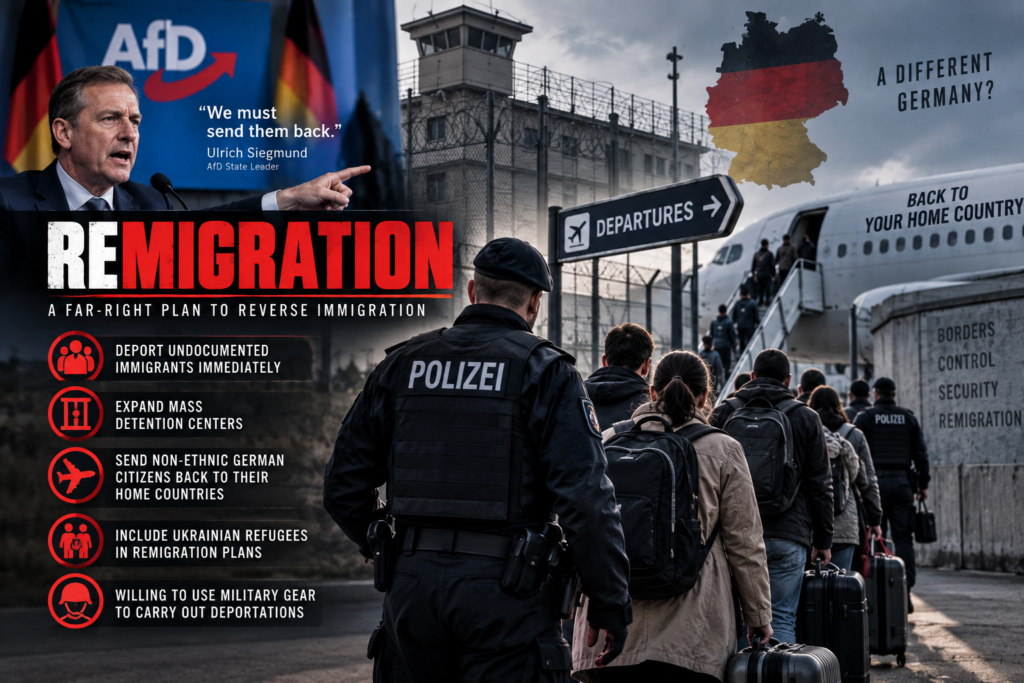
But there is a big catch. Most of these promises cannot become law. Germany is a federal country. States do not control immigration. An analysis by the public broadcaster ARD found that about two thirds of the AfD state plan is legally impossible. One third of it falls under federal power. Another third breaks the German constitution, EU law, or international treaties. For example, EU law says anyone seeking protection can ask for asylum at the border. States must also take in asylum seekers under a fixed formula. Separate classes for refugees would likely break EU anti discrimination rules and the European Convention on Human Rights.
So even if the AfD joins a state government, its hardest plans would hit a legal wall. But that does not mean life stays the same. In fact, the gap between what the party promises and what it can deliver creates deep uncertainty. That uncertainty shapes daily life.
Three Pressures on International Students
One: visa checks are getting tighter, quietly.
The shift started before the election. In November 2025, a Berlin court ruled that fully online or mostly online study programs no longer qualify for a student visa. The court’s logic was simple. If you can study from anywhere, you do not need to be in Germany.
That ruling is now shaping real decisions. Students are seeing their visa renewals rejected. In some cases, existing permits have been canceled after the fact. Students in online programs at private schools have been hit hardest. But the scrutiny is spreading. One immigration lawyer called the trend legal but worrying. It is really just wider immigration tightening landing on the education sector.
Two: the social mood is getting colder.
A 2025 survey by Times Higher Education showed how students actually feel this shift. A business student from Kenya in Thuringia said AfD talk has made her uneasy. She has faced racial discrimination. Now she watches her surroundings all the time. The open hostility, she said, is impossible to ignore. It leaves you lonely, anxious, and unsure you belong.
She is not alone. After the AfD win in Saxony Anhalt, migrant rights workers described a feeling of despair. A social worker from Ivory Coast said that after the results came in, nobody wanted to eat.
Three: the economy pulls in the other direction.
Here is the bitter irony. Germany’s economy and schools need foreign talent more than ever. Data from the German Academic Exchange Service shows about 99,000 new international students started in the 2025 26 winter term. That is a nine percent rise from a year earlier. Total international students now top 420,000. Nearly half of German universities plan to add more English taught programs in 2026.
Even more telling, Germany’s 2026 immigration changes actually made life easier after graduation. The job search window went from 18 months to 24 months. Part time work limits were removed. The points bar for the opportunity card was lowered. The reason is not kindness. It is a severe shortage of skilled workers.
So Germany faces a contradiction. It needs foreign students to fill jobs. But far right politics frames foreigners as the problem itself.
What Comes Next
For students in Germany or planning to go, here is the honest picture. The risk of open institutional bias stays low for now. But the social and emotional cost is rising over time.
At the state level, AfD power is limited by federal law. Mass deportations and broad discrimination cannot legally happen. But the rightward shift in public talk is already changing how officials use their discretion. The Berlin court ruling on online study is proof. When doubt about immigrants becomes mainstream, even clean visa applications get a harder look.
For each student, the choice is now more complex. Germany’s free public universities and strong job market are still real draws. The 2026 changes truly open the path to stay and work after graduation. But if you come from outside the EU, and especially if you are a person of color, you must weigh the academic chance against daily life more carefully than before.
German universities are becoming a shield. Student groups at several schools have spoken out against far right attacks on academic freedom and exchange. But that shield has limits. A university cannot stop a student from being harassed on the street. It cannot stop a visa office from judging a renewal with a harsher eye.
The AfD win is not the end. It is a signal. The signal is clear. Germany’s politics are being reshaped. The place of foreigners in that reshaping is more uncertain than at any time in seventy years. For people who see Germany as their future, that uncertainty is a cost in itself. Visit News and Noise Homepage for more articles.


The conversation