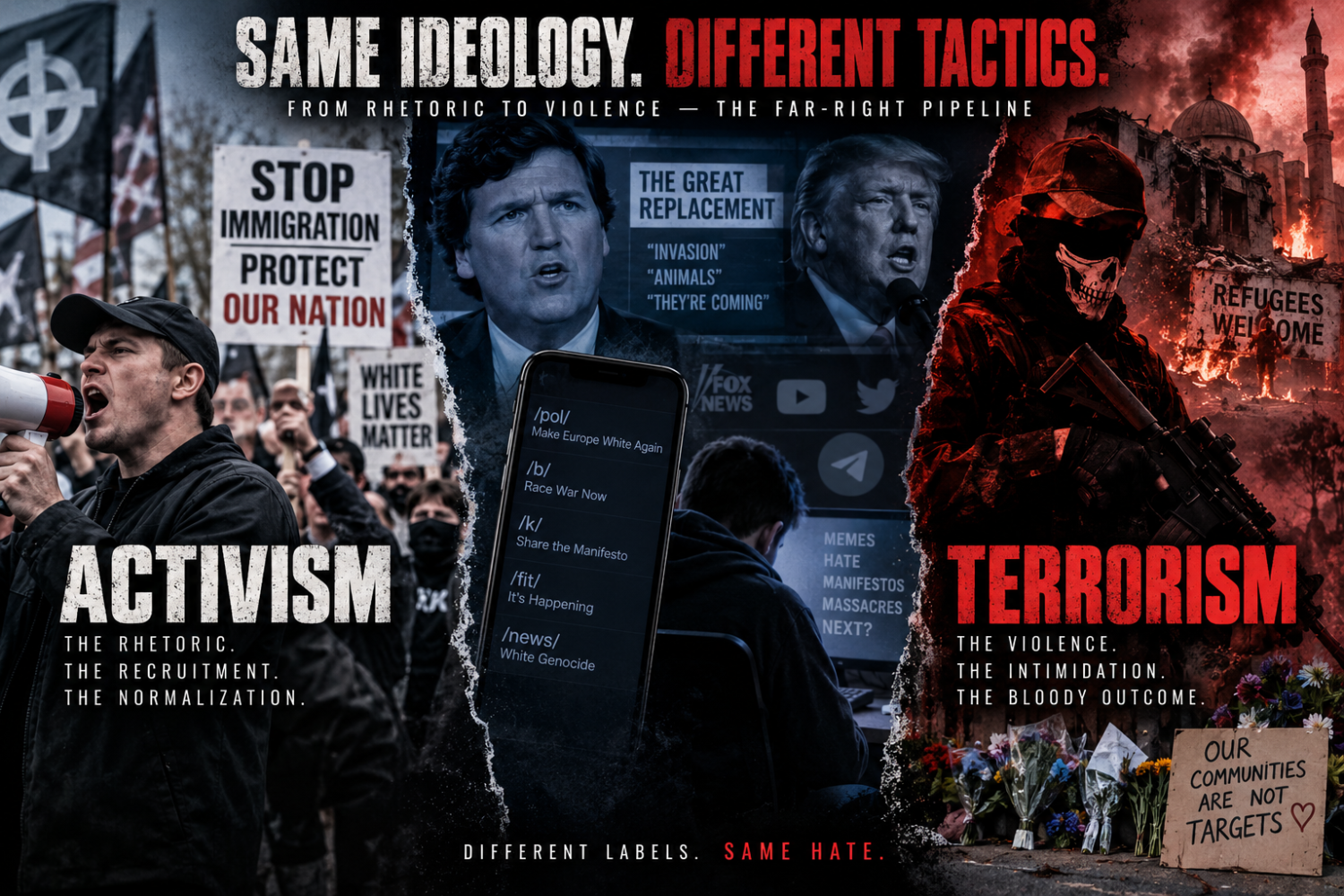
In the aftermath of any politically motivated attack, a familiar media narrative emerges, one scrambles to categorize the perpetrator. Was he a “lone wolf“? A “troubled individual“? Or, the most politically charged label of all, a “terrorist“? When the violence stems from Islamic extremism, the label “terrorist” is applied with immediate and unquestioning certainty. when the violence erupts from the far right, a curious semantic fog descends. The perpetrators are often described as “activists,” “protesters,” or “nationalists” who simply took their beliefs “too far.”
This linguistic hesitation is not accidental. It is a deliberate rhetorical strategy that sustains a dangerous double standard. To understand the modern landscape of political violence, we must first define our terms. The distinction between a far-right activist and a far-right terrorist is not a matter of ideology, but of methodology. However, the line between the two is not a wall; it is a porous, shifting membrane, constantly pushed and blurred by a symbiotic ecosystem of supporters, media pundits, and political enablers. The goal of this obfuscation is simple: to legitimize a white nationalist agenda while delegitimizing its opponents, effectively modernizing terrorism by rebranding it as a grassroots movement.
Defining the Actors: The Activist and the Terrorist
A far-right activist is an individual who works to promote ultranationalist, white supremacist, xenophobic, or authoritarian ideologies within the bounds of what is legally permissible. Their tools are political rallies, propaganda distribution, online campaigning, and harassment. They seek to shift the Overton window. The range of policies acceptable to the mainstream by normalizing their hateful rhetoric. They organize “protests” against immigration, will not include or multiculturalism. They run for local office. They use social media to build communities of like minded individuals, creating a permission structure for prejudice. While their goals are often abhorrent and their rhetoric inherently violent, their public-facing actions stop short of direct, organized physical violence. They are the ideological shock troops, the recruiters, and the propagandists.
A terrorist, by contrast, is defined by their use of unlawful violence and intimidation, especially against civilians, in the pursuit of political aims. A far-right terrorist, therefore, is an individual or group that employs this tactic to advance a white supremacist or ultranationalist agenda. The goal is not persuasion but coercion through fear. The 2019 Christchurch mosque shootings, the 2011 Norway attacks, and the 2015 Charleston church shooting are textbook examples of far-right terrorism. These acts are designed to create a climate of terror, to spark a “race war,” and to physically eliminate perceived enemies.
On paper, the distinction seems clear: one uses politics, the other uses violence.
In reality, this is a distinction without a difference. The activist and the terrorist are not separate entities; they are two sides of the same bloody coin.
The Ecosystem of Support: The Enablers and the Apologists
The rise of modern far right terrorism is not a spontaneous phenomenon. It is cultivated by a vast and interconnected support network. This network includes media personalities who demonize minority groups, politicians who use coded language to stoke racial grievances, and online platforms that provide a haven for radicalization.
Figures like Tucker Carlson, with his nightly broadcasts warning of a “great replacement” of white Americans, provide the ideological fuel. This rhetoric, which frames demographic change as an existential threat, is not mere commentary; it is a call to arms. When a terrorist like Payton Gendron cites this “great replacement” theory as his motivation before murdering ten Black people in a Buffalo supermarket, the line between the pundit and the perpetrator becomes terrifyingly thin. The politician who calls immigrants “animals” or describes a caravan of refugees as an “invasion” is not an innocent bystander. They are actively creating the conditions for violence.
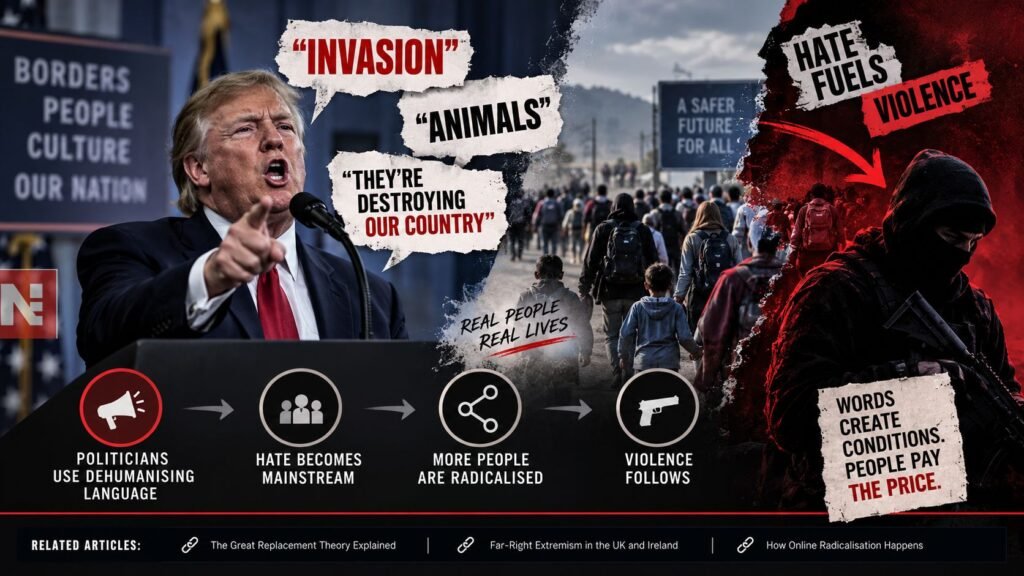
Then there are the online ecosystems—forums like 4chan, 8chan, and Telegram channels—where young men are radicalized in a matter of months. Here, “activism” is a gateway drug. A teenager might start by watching a “humorous” anti-feminist YouTube video, then be led to a forum discussing “white genocide,” and finally be directed to a manifesto and a livestream of a massacre. The algorithm doesn’t distinguish between the activist and the terrorist; it simply sees an engaged user.
Finally, there is the mainstream media and political establishment, which consistently grants far-right terrorists a “lone wolf” status. This label is a form of absolution. It absolves the broader movement of responsibility and allows the ideology to remain respectable. When a white man commits an act of mass murder, he is a “deranged individual.” When a Muslim man does the same, he is an “ISIS-inspired terrorist.” This double standard is not just lazy journalism; it is a form of ideological policing that protects the powerful and demonizes the other.
The “Tradition” of Terror in Ireland
This dynamic is not unique to the United States. In the Ireland, a similar pattern has emerge, albeit with a distinctly local flavor. For years, far-rights activists have attempted to co-opt legitimate concerns about housing and immigration, organizing small often violent protests. These groups, like those in the US, claim to be “patriots” defending their communities.
However, their actions betray their true nature. The burning of a mosque in Ireland, or the arson attacks on hotels housing refugees, are not acts of “protest.” They are acts of terrorism, pure and simple. They are designed to terrorize a specific community. Muslims and asylum seekers and to force a political outcome through fear. The individuals who carry out these attacks are not “activists” who got carried away. They are terrorists who were radicalized by a global white nationalist movement that has found fertile ground in Ireland’s own history of sectarian conflict and its recent economic anxieties.
When a mob, egged on by far-right agitators, chants anti-immigrant slurs outside a refugee center, the activists are there, setting the stage. When that same center is later firebombed, the terrorists have taken the final step. To pretend these two events are unrelated is to be willfully blind. The activist creates the climate of hate; the terrorist acts upon it.
Conclusion: Calling Terror by Its Name
The distinction between far-right activism and far-right terrorism is a dangerous illusion, a rhetorical trick designed to protect white supremacy from the full weight of the law and public opinion. The activist and the terrorist share the same ideology, the same goals, and the same ecosystem of support.
Modern far-right terrorism has been “modernized” not by new weapons, but by a new strategy of plausible deniability. The violence is decentralized, the propaganda is crowdsourced, and the leaders are podcasters and politicians who can claim they never explicitly told anyone to kill. Yet the bodies pile up all the same.
It is time for the media, law enforcement, and the public to stop splitting hairs. We must recognize that the “activist” who organizes a rally where Nazi salutes are given is not a protestor; they are a fascist. The “nationalist” who shares a manifesto online is not a commentator; they are an accessory to murder. And the person who drives a car into a mosque or shoots worshippers in a church is not a “lone wolf.” They are a terrorist, acting as the violent vanguard of a movement that has been allowed to fester in the mainstream for far too long.
We cannot fight what we refuse to name. Until we apply the same moral and legal clarity to right-wing violence that we do to all other forms of terrorism, the cycle of radicalization, violence, and denial will continue. The first step in dismantling this threat is to stop calling it activism and start calling it what it is: terrorism. Read more at News and Noise.

The conversation